We support people working in the health and care sector across south London, as well residents and communities, to make sense of applied health and care evidence and understand how it might be used in different settings, to improve outcomes or experiences.
Principles that guide our knowledge mobilisation
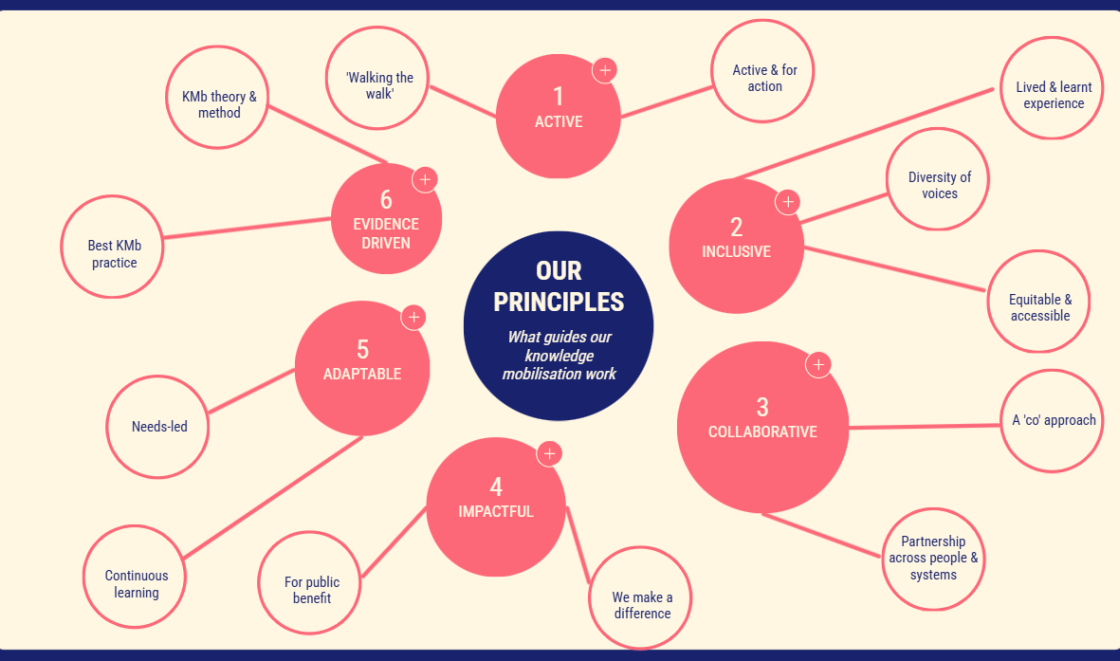
We work across six principles to make sure research evidence is useful. In all our knowledge mobilisation work, we are: active, inclusive, collaborative, impactful, adaptable and evidence-driven (see diagram below).
Our programme of work
We bring these principles alive in our work. Our programme includes:
- Developing a Research-practice Partnership, initially focusing on improving the health and wellbeing of people in prison, those who have been in prison and their families
- Collaboration with Lambeth HEART (NIHR Health Determinants Research Centre), which aims to understand and act on the causes of health inequalities in Lambeth
- Working with applied health researchers to support their work, including through developing knowledge mobilisation (KM) case studies:
- Social care knowledge mobilisation
- Alcohol Assertive Outreach knowledge mobilisation
- Diabetes care knowledge mobilisation
- Evaluating our activities to understand their impact
- Developing regional (pan-London) and national networks and collaborations, and sharing learning and insights
- Public and patient involvement and engagement in knowledge mobilisation
Our dedicated team of knowledge mobilisation experts is led by Professor Annette Boaz and Zoe Lelliott at King’s College London, working collaboratively with the ARC’s implementation team and the Health Innovation Network South London, as well as the knowledge mobilisation and implementation community across London.